
The Satellite Company AT&T and Verizon Bet $1.2 Billion On, Before It Had Any Revenue to Show For It
- Hawkmont Research

- Jun 30
- 14 min read
Hawkmont Research | Equity Research | Satellite Connectivity & Space-Based Telecom
June 30, 2026 | INITIATING COVERAGE
This report is produced independently by Hawkmont Research. No compensation was received from any company mentioned herein. All prices and market data as of June 2026 unless otherwise noted. This is not investment advice. Please read full disclosures at the end of this report.
No Rating | Current Price: ~$86 | Market Cap: ~$33.5 billion
Metric | Value |
Market Cap | ~$33.5 billion |
52-Week Range | $36.08 / $133.86 |
Q1 2026 Revenue | $14.7 million (vs. $37.5M consensus, missed) |
FY2026 Revenue Guidance | $150 million to $200 million |
2027 Revenue Target (management) | Approaching $1 billion |
Q1 2026 Net Loss | $191.0 million (EPS -$0.66) |
Cash & Equivalents (3/31/26) | ~$3.5 billion |
Contracted Revenue Commitments | Over $1.2 billion from ~60 global MNO partners |
Satellites Targeted End of 2026 | ~45 in orbit |
Next Earnings | August 17, 2026 (Q2 2026, est.) |
THESIS: AST SpaceMobile is building the first space-based cellular broadband network designed to connect directly to ordinary, unmodified smartphones, no special hardware required. The company has signed nearly 60 mobile network operator partners covering more than three billion subscribers, including AT&T, Verizon, Vodafone, and Rakuten, and has secured FCC authorization to operate commercially in the United States on premium low-band spectrum. The stock has moved from roughly $36 to as high as $134 over the trailing year, then corrected sharply, then rallied again, a level of volatility that reflects a company still pre-revenue at scale. Hawkmont Research initiates coverage on ASTS with no rating. The technology has cleared real milestones. The financial model remains almost entirely a forward-looking story, funded by a fortress balance sheet and underwritten by contracted commitments that have not yet converted into meaningful revenue. This report explains what AST SpaceMobile is actually building, why the world's largest carriers are betting on it, and what has to go right for the current valuation to make sense.
Table of Contents
Executive Summary
What AST SpaceMobile Actually Builds (And Why It Is Hard to Replicate)
The Spectrum and Carrier Moat: Why AT&T and Verizon Signed On
The Government Angle: Space Force, FirstNet, and the National Security Layer
Financial Analysis: A Pre-Revenue Company With a Massive War Chest
Valuation: What the Market Is Now Pricing In
Risks to the Thesis
Disclosures
Section 1: Executive Summary
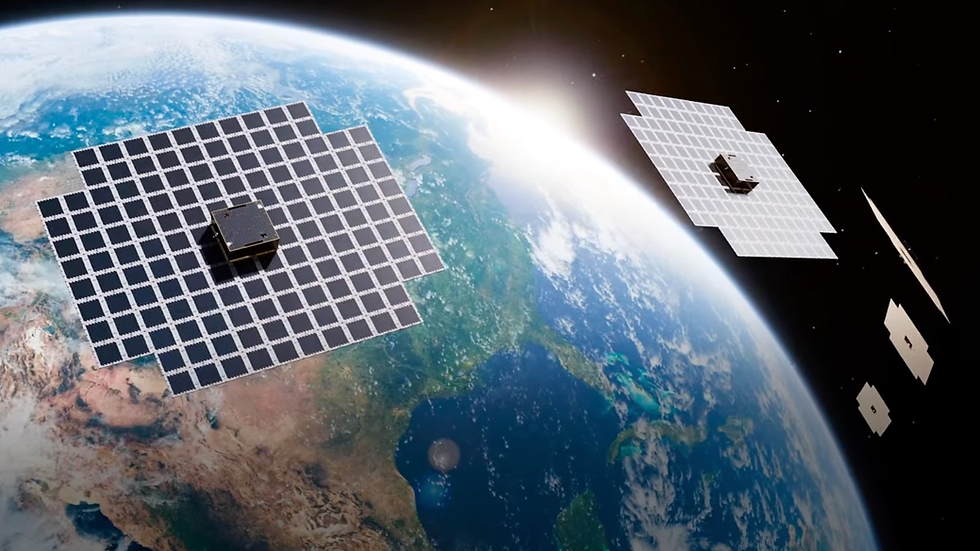
AST SpaceMobile was founded in 2017 by Abel Avellan and is headquartered in Midland, Texas. The company's stated mission is to eliminate mobile dead zones permanently, building a constellation of large, custom-built satellites, known as BlueBirds, that can connect directly to standard smartphones already in people's pockets. No new phone. No special antenna. No app. The technology works through the existing terrestrial network architecture of partner carriers, a design choice the company calls its bent pipe system integration model.
This is a fundamentally different approach from Starlink's direct-to-cell ambitions or Iridium's legacy satellite phone business. AST SpaceMobile is not selling a standalone satellite service. It is selling spectrum-sharing infrastructure to the carriers themselves, who then offer space-based coverage as an extension of their existing networks. That structural choice is the reason nearly 60 global mobile network operators, representing more than three billion subscribers, have signed on, including AT&T, Verizon, Vodafone, Rakuten, stc, Bell Canada, and TELUS.
The financial picture, however, remains in the earliest stages of commercialization. Q1 2026 revenue came in at $14.7 million, well below the $37.5 million consensus estimate, driven by the timing of gateway equipment deliveries and government contract milestones rather than any underlying demand problem. The company posted a net loss of $191.0 million for the quarter. Full-year 2026 revenue guidance of $150 million to $200 million was reiterated, with management indicating roughly half of that figure is already contracted. Management has also pointed to 2027 revenue approaching $1 billion as satellites come online and commercial service scales.
The balance sheet is the part of this story that looks nothing like a typical pre-revenue company. AST SpaceMobile held approximately $3.5 billion in cash, cash equivalents, and restricted cash as of March 31, 2026, giving management room to say the company is fully funded for its planned constellation of approximately 90 satellites without near-term dilution risk.
The stock has reflected all of this uncertainty. ASTS traded as low as $36 and as high as $134 over the trailing year, a swing of more than 270% peak to trough to peak, before settling in the mid-$80s. That kind of volatility is what happens when a company's valuation is built almost entirely on a multi-year forward narrative rather than trailing financial results.
Hawkmont Research initiates coverage with no rating. The commercial validation from major carriers is real and difficult to dismiss. The cash position genuinely de-risks the funding question. The revenue, however, is still a fraction of what the valuation implies, and the company's own Q1 2026 miss is a reminder that the gap between contracted commitments and recognized revenue can be wide and uneven from quarter to quarter.
Section 2: What AST SpaceMobile Actually Builds (And Why It Is Hard to Replicate)
AST SpaceMobile's core product is the BlueBird satellite, the largest commercial communications array ever deployed in low Earth orbit, with Block 2 satellites measuring roughly 2,400 square feet each. These are not small relay satellites. They are purpose-built, phased-array broadband platforms designed to beam a usable cellular signal directly down to an ordinary smartphone, something no commercial satellite operator had achieved at scale before AST SpaceMobile's earlier Block 1 launches.
The company describes its manufacturing as approximately 95% vertically integrated, building its own satellite buses, antenna arrays, and key electronics rather than relying on a long external supply chain. That vertical integration is partly a defensive choice. A constellation business with hundreds of satellites planned cannot afford the lead times and margin stacking that come from outsourcing critical components, and it gives AST SpaceMobile more control over the production cadence needed to reach its 2026 satellite count targets.
The technology itself rests on a deep patent position, approximately 3,900 patents and patent-pending claims covering the direct-to-device architecture and the integration methods that let a BlueBird satellite talk to a carrier's existing network core over standard 3GPP protocols. This patent estate is one of the more underappreciated parts of the moat. A competitor cannot simply launch similar satellites and expect to interoperate cleanly with AT&T's or Verizon's network infrastructure without running into AST SpaceMobile's intellectual property.
On June 17, 2026, AST SpaceMobile launched BlueBirds 8, 9, and 10 aboard a SpaceX Falcon 9 from Cape Canaveral, and the company has subsequently announced BlueBirds 11, 12, and 13 are targeted for launch in the first half of 2026's back half, with these later units carrying larger arrays designed to boost peak data speeds beyond what the initial Block 2 satellites achieved. Production has moved past BlueBird 37, and management has described a plan for regular monthly-to-bimonthly launch cadence going forward, a meaningfully different operating tempo than the company's earlier years of sporadic, single-satellite missions.
On-orbit performance has also improved. The company has reported achieving peak data speeds of 98.9 Mbps on its Block 1 satellites, with management expecting Block 2 satellites to nearly double that figure once enabled with sufficient spectrum on a region-by-region basis. AI edge computing and AI-driven spectrum management capabilities are also being developed for integration into next-generation BlueBirds, targeting production by year-end 2026, a feature set aimed at squeezing more usable bandwidth out of a finite amount of allocated spectrum as the constellation scales.
Section 3: The Spectrum and Carrier Moat: Why AT&T and Verizon Signed On
The single most important structural fact in the AST SpaceMobile story is that the company does not need its own dedicated spectrum allocation to operate. It uses its carrier partners' existing licensed spectrum, the same spectrum AT&T or Verizon already owns for terrestrial service, extended into space. This is the mechanism that turns potential competitors into partners. A carrier has every incentive to work with AST SpaceMobile rather than against it, because the alternative is ceding dead-zone coverage entirely to a rival network.
This dynamic has produced a genuinely broad coalition. The company's ecosystem includes close to 60 global mobile network operator partners covering more than three billion subscribers, with key relationships including AT&T, Verizon, Vodafone, Rakuten, stc, Bell Canada, and TELUS, the last of which signed on as a second Canadian partner alongside Bell. AXIAN Telecom was also added as a pan-African operator spanning eleven countries, extending the network's geographic reach well beyond North America and Europe.
These relationships are not symbolic. AST SpaceMobile has disclosed more than $1.2 billion in contracted revenue commitments from its commercial partners, tied to gateway equipment deliveries, network integration work, and future service revenue as the constellation matures. The Verizon relationship in particular has been structured to target full geographic coverage of the continental United States, while the stc Group agreement in Saudi Arabia carries a ten-year term and included a $175 million prepayment for future services, an unusually strong signal of carrier conviction for a company still building out its network.
Regulatory clearance is the other half of the moat. AST SpaceMobile has received FCC authorization to operate its BlueBird constellation commercially in the United States, enabling direct-to-device connectivity on premium low-band spectrum in coordination with Verizon, AT&T, and FirstNet. The company has described a broader spectrum strategy capable of tuning across approximately 1,100 megahertz of low-band and mid-band spectrum globally, a flexibility that lets it adapt to whichever partner's spectrum holdings are available in a given market rather than being locked into a single band.
It is worth noting that this moat is not unchallenged. In June 2026, AT&T, T-Mobile, and Verizon announced a joint venture of their own to extend mobile connectivity using satellite-based, direct-to-device technologies, a development AST SpaceMobile publicly commended rather than criticized, framing it as validation of the broader category. Whether that joint venture ultimately routes meaningful volume through AST SpaceMobile specifically, through a competitor, or through some blended multi-vendor arrangement is one of the more important open questions for the multi-year thesis.
Section 4: The Government Angle: Space Force, FirstNet, and the National Security Layer
Alongside the commercial carrier business, AST SpaceMobile has built a meaningful government and defense pipeline that gets less attention than the AT&T and Verizon headlines but is structurally important to the 2026 and 2027 revenue ramp. The company's FCC authorization explicitly includes coordination with FirstNet, the dedicated public safety broadband network built for first responders, positioning AST SpaceMobile's coverage as critical infrastructure for emergency communications in areas without terrestrial signal.
Management has pointed to a proposed Space Force budget exceeding $70 billion as a structural tailwind, and the company disclosed three additional U.S. government awards through prime contractors during Q1 2026 alone, on top of milestones already in progress under existing contracts, including work tied to the Space Development Agency. Roughly half of the Q1 2026 revenue that did materialize was tied to government contract milestones rather than commercial gateway deliveries, underscoring that the government channel is not a side project but a current, recognized source of revenue.
This government exposure also functions as a form of de-risking for the broader thesis. Government contracts, particularly those tied to national security and emergency communications resilience, tend to be less sensitive to the kind of commercial demand cyclicality that could affect carrier rollout timing. A constellation capable of providing connectivity anywhere on the globe, independent of terrestrial cell towers, has obvious utility for military and disaster-response applications regardless of how quickly consumer adoption scales.
The risk on this side of the business is execution and contract timing rather than demand. Government milestone-based revenue is, by its nature, lumpy. The Q1 2026 revenue shortfall was attributed in part to the timing of government contract milestone completions sliding outside the quarter, a pattern that is likely to recur as the company continues to lean on milestone payments rather than steady-state recurring service revenue.
Section 5: Financial Analysis: A Pre-Revenue Company With a Massive War Chest
5.1 Recent Quarterly Trend
Metric | Q4 2025 | Q1 2026 |
Revenue | n/a (FY guidance basis) | $14.7 million |
Net Loss | n/a | $191.0 million |
EPS (GAAP) | n/a | -$0.66 |
Adjusted Operating Expenses | $95.7 million | $91.2 million |
Adj. Opex ex. Cost of Revenue | $66.8 million | $79.8 million |
Cash, Equivalents & Restricted Cash | n/a | ~$3.5 billion |
The headline number from Q1 2026 is the revenue miss: $14.7 million against a consensus estimate of $37.5 million, a shortfall of roughly 61%. Management attributed this directly to the timing of gateway equipment deliveries to commercial partners and the completion timing of certain government contract milestones, not to any underlying weakening in partner demand. The stock actually rose following the print, suggesting the market read the miss as a timing issue rather than a demand issue, helped along by the reiteration of full-year guidance and continued progress on satellite deployment.
Operating expenses tell a more encouraging story on their own. Adjusted operating expenses fell to $91.2 million in Q1 2026 from $95.7 million in Q4 2025, even as the company ramped manufacturing and launch activity, evidence that some of the scale benefits of vertical integration are beginning to show up in the cost structure. Capital expenditures, by contrast, were substantial and variable, ranging from $257 million to $406.7 million in the quarter, with gross property and equipment reaching $1.8 billion, reflecting the capital intensity of building out a satellite constellation and ground infrastructure simultaneously.
5.2 The Cash Position: The Real Story
AST SpaceMobile's approximately $3.5 billion cash position as of March 31, 2026, bolstered by a recent convertible debt raise, is arguably the single most important number in this report. It is what allows management to credibly state the company is fully funded for its planned constellation of approximately 90 satellites without needing to return to capital markets under duress. For a company burning meaningfully more cash than it generates in revenue, that funding runway converts an otherwise speculative story into one where the company has real optionality to execute on its own timeline rather than the market's.
That said, a large cash balance funds a plan. It does not validate the plan's commercial outcome. The $1.2 billion in contracted revenue commitments from carrier partners is a meaningful forward indicator of demand, but it is not the same as recognized revenue, and the conversion rate from contracted commitment to actual cash received has, so far, been slower and lumpier than initial guidance implied.
5.3 Guidance and the Path to 2027
Management has reiterated full-year 2026 revenue guidance of $150 million to $200 million, with roughly half already covered by existing contracted backlog, and has pointed to 2027 revenue approaching $1 billion as the constellation reaches the 45-to-60 satellite range needed for continuous service in key markets. That is a roughly five-to-six-fold increase in a single year, a trajectory that depends entirely on the company hitting its satellite deployment cadence, converting contracted commercial commitments into live, billable service, and avoiding the kind of milestone timing slippage that hit Q1 2026.
Section 6: Valuation: What the Market Is Now Pricing In
6.1 A Valuation With No Earnings Anchor
Metric | Value |
Market Cap | ~$33.5 billion |
TTM Revenue | ~$85 million |
TTM Net Income | Negative (TTM EPS -$1.79) |
TTM Price / Sales | Approximately 390x |
FY2026 Revenue Guidance | $150M to $200M |
Implied Forward Price / Sales (midpoint guidance) | Approximately 191x |
Average Analyst 12-Month Target | ~$81, range $41 to $108 |
There is no meaningful trailing earnings multiple to anchor this valuation. AST SpaceMobile trades at roughly 390 times trailing twelve-month revenue, and even using the midpoint of management's aggressive 2026 guidance, the forward price-to-sales multiple remains in the neighborhood of 190 times. These are not metrics that map onto traditional valuation frameworks. They reflect a market that is pricing AST SpaceMobile almost entirely on the multi-year 2027 and beyond revenue ramp, the size of the carrier coalition behind it, and the scarcity value of being the most advanced direct-to-device satellite operator with regulatory clearance already in hand.
6.2 The Bull Case
The bull case rests on three pillars holding simultaneously: the contracted commercial backlog converting into recurring service revenue as satellite count scales past the 45-to-60 threshold management has identified for continuous coverage, the government and defense channel continuing to expand alongside a growing Space Force budget, and the company's vertical integration translating into the kind of unit economics that let a constellation business scale margin rather than just revenue. If 2027 revenue does approach the $1 billion management has guided toward, and the market begins applying even a generous software-like multiple to that figure rather than today's pre-revenue multiple, there is a credible path for the current valuation to look reasonable in hindsight.
6.3 The Bear Case
The bear case is built on the gap between contracted commitments and cash collected, illustrated cleanly by the Q1 2026 miss. A $1.2 billion contracted backlog is a real signal of intent from serious counterparties, but it is not revenue, and the conversion timeline has already proven less predictable than initial guidance suggested. The wide dispersion in analyst price targets, from $41 to $108, reflects genuine disagreement about how quickly that backlog converts and whether the 2027 trajectory is achievable on the stated timeline. At a valuation pricing in years of flawless satellite deployment, carrier monetization, and government contract execution, any meaningful delay, whether from a launch anomaly, a spectrum dispute, or slower-than-expected carrier rollout, is likely to produce an outsized stock reaction in either direction.
Section 7: Risks to the Thesis
Revenue recognition timing and lumpiness. Q1 2026 demonstrated how sensitive quarterly results are to the timing of gateway deliveries and government milestone completions, a pattern likely to persist as the company scales.
Execution risk on satellite deployment. The 2026 and 2027 revenue targets depend on hitting a satellite count of roughly 45 by year-end 2026 and 45 to 60 for continuous coverage, on a launch cadence that has already included at least one disclosed launch anomaly involving a partner provider.
Carrier concentration and the AT&T, T-Mobile, Verizon joint venture. The June 2026 announcement of a satellite connectivity joint venture among the three largest U.S. carriers introduces uncertainty about how much future volume routes through AST SpaceMobile specifically versus a competing or blended vendor arrangement.
Capital intensity and ongoing cash burn. Despite the $3.5 billion cash position, capital expenditures have run as high as $400 million-plus in a single quarter, and continued heavy investment will be required well before the business approaches positive free cash flow.
Valuation risk. At multiples with no historical precedent in traditional equity analysis, any disappointment relative to the aggressive 2026 and 2027 revenue ramp is likely to trigger sharp multiple compression independent of underlying technological progress.
Regulatory and spectrum dependency. The business model relies on continued cooperation and spectrum access from carrier partners and continued FCC and international regulatory support; any material shift in spectrum policy or partner posture would directly affect the network's reach.
Competitive response. Starlink's direct-to-cell initiative and other emerging satellite-to-device efforts represent a competitive field that did not exist at this scale even two years ago, and the category's economics are still being defined in real time.
A Note on Coverage Approach
Hawkmont Research does not issue buy/sell recommendations. Our role is to provide independent, conflict-free analysis of the underlying business and let investors reach their own conclusions.
AST SpaceMobile has cleared technical and regulatory hurdles that looked highly uncertain just a few years ago. The carrier coalition is real, the FCC authorization is real, and the cash position genuinely removes near-term funding risk from the conversation. The revenue, however, remains a small fraction of what the current valuation implies, and Q1 2026 was a clear reminder that the path from contracted commitment to recognized, recurring revenue is neither smooth nor fully predictable yet.
Both of those things can be true at once. That is exactly the situation that makes a clean rating unhelpful and a careful read of the underlying business essential.
Get the Next Report Before Anyone Else
This report is free.
Hawkmont Research covers asymmetric opportunities in global equities, emerging tech supply chains, and high-conviction macro themes. Independently, with no sell-side affiliations and no advertiser relationships.
Hawkmont Research | hawkmontresearch.com | June 30, 2026
Research is conflict-free. No sell-side affiliations. No advertiser relationships.
Disclosures and Important Notices
Hawkmont Research is an independent research firm. The authors of this report do not hold positions in any of the securities mentioned at the time of publication. This report is produced for informational and educational purposes only and does not constitute investment advice, a solicitation, or an offer to buy or sell securities.
Past performance does not guarantee future results. Investing involves risk including the potential loss of principal. Readers should conduct their own due diligence and consult a qualified financial advisor before making investment decisions.
No compensation was received from any company mentioned in this report. Hawkmont Research has no investment banking relationships with any company mentioned herein. No sell-side affiliations. No advertiser relationships.
All prices and market data as of late June 2026 unless otherwise noted. AST SpaceMobile shares have shown elevated volatility, and readers should verify current pricing independently before drawing valuation conclusions. Financial estimates and assessments not directly attributed to company guidance or named sources are Hawkmont Research's synthesis of publicly available reporting and should not be attributed to company guidance or consensus.
Hawkmont Research does not issue buy/sell/hold ratings on individual securities. Coverage initiation reflects our assessment that a company merits detailed independent analysis. It is not a recommendation to take any investment action.
